
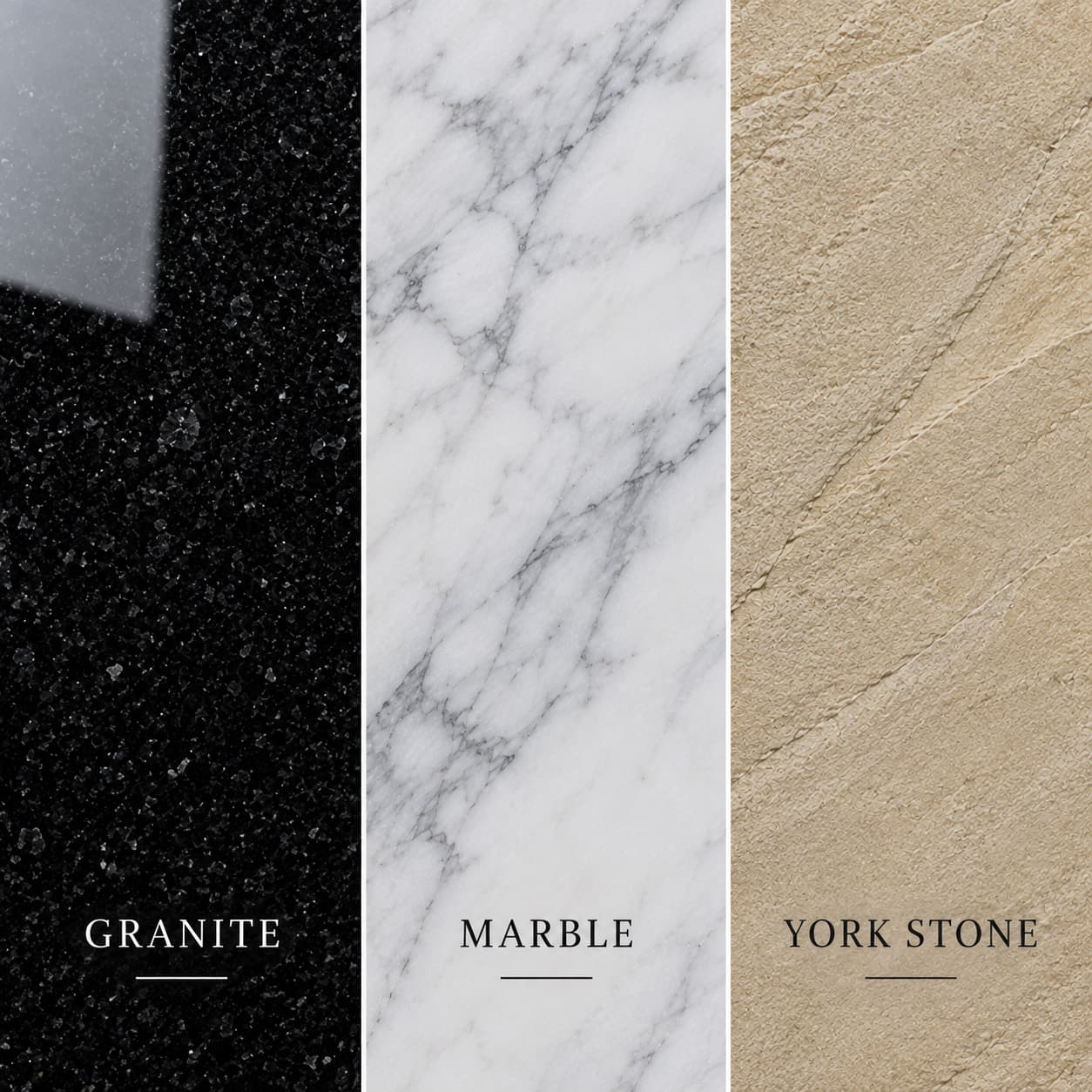
Granite vs Marble vs York Stone: Which Is Best for a Headstone?
One of the first decisions to make when choosing a memorial is what material it should be made from.
For most new memorials, the choice will usually be between granite, marble and natural stone. At Memorials of Elegance, the natural stone we use for the vast majority of these requirements is York stone.
Each has its own advantages and gives a very different finished appearance. There isn't necessarily one material that is better than the others in every situation. Your choice can depend on the appearance you're looking for, the burial ground regulations, how you would like the memorial to age and how much maintenance you're prepared to carry out in the future.
This guide covers the main differences and some of the things worth considering before making your choice.
Granite Memorials
Granite is by far the most popular material we use for new memorials.
It is extremely hard-wearing, available in a huge range of colours and can be produced with several different surface finishes. Polished black granite is probably the most recognisable, but granite is available in greys, blues, reds, greens and many other colours.
It can also be polished, honed or finished with natural-looking pitched and rustic edges depending on the style of memorial.
One of the biggest advantages of granite is its versatility.
Lettering can be sandblasted into the surface and finished in gold leaf, silver or a range of painted colours. We can also add sandblasted ornaments, detailed designs, ceramic photographs and, particularly on black granite, highly detailed laser-engraved images.*
*laser engraved images are produced by our suppliers, so can increase lead time on a memorial.
For someone looking for a memorial that will retain a clean, crisp appearance for many years with relatively little maintenance, granite is usually our first recommendation.
How much maintenance does granite need?
Not a great deal.
Like anything permanently exposed to the British weather, granite will still collect dirt, pollen, bird droppings and other deposits. Its surroundings also make a difference, particularly if the memorial is positioned beneath trees.
Polished granite itself is very durable, although painted and gilded lettering needs to be treated more carefully.
We've put together a separate guide covering how to safely clean and care for a polished granite memorial, including what you can do yourself and the products and cleaning methods we recommend avoiding.
Marble Memorials
Marble has been used for memorials for generations and gives a much softer, more traditional appearance than polished granite.
White marble is probably the type most people will recognise. It has natural veining running through the stone, meaning every piece is slightly different.
It is, however, softer and more porous than granite.
Over time, marble will naturally weather. Its surface can become discoloured and more susceptible to biological growth, particularly depending on where the memorial is positioned. Fine details and lettering can also gradually soften as the stone ages.
This doesn't mean marble isn't suitable for a memorial. There are marble memorials that have stood in cemeteries for generations. It simply needs to be chosen with the understanding that it will age differently to polished granite and may require more maintenance over its lifetime.
If you like the traditional appearance of marble, we're happy to discuss the options available. We don't always have marble memorials on display, so if you're making a special journey specifically to see marble, we'd recommend contacting us beforehand.
York Stone Memorials
For the vast majority of our natural stone memorials, we use York stone.
York stone has a completely different appearance to polished granite. It has a natural texture and variation in colour, and is particularly well suited to traditional memorial designs.
It is also an excellent material for hand-carved ornamentation.
For churchyards in particular, York stone can sometimes be a more appropriate choice than polished granite. Individual churchyards and burial grounds have their own regulations, however, so the permitted material, finish and design should always be checked before a memorial is ordered.
Like marble, York stone should be expected to change in appearance as it ages.
Weathering, natural colour changes and biological growth are all part of the way the material develops over time. Look around an older churchyard and you'll see plenty of examples of natural stone memorials that have been standing for many decades.
If you want the memorial to remain highly polished and relatively unchanged in appearance, granite will usually be the more suitable option.
If you're looking for something more traditional, York stone can be an excellent choice.
Can I Choose Any Material I Want?
Not always.
The cemetery or churchyard where the memorial will be installed may have regulations covering the materials, dimensions, finishes, inscriptions and ornamentation that are permitted.
Churchyards can be particularly strict, and highly polished granite may not be permitted in some locations.
Before we manufacture a memorial, we can check the relevant regulations and advise on what is suitable. We also handle the necessary memorial application as part of the process.
It's always worth checking this before becoming set on a particular material or design.
What About the Inscription?
There is much more to consider than simply fitting a name and dates onto the memorial. The layout, amount of wording and whether further inscriptions may be needed in the future should all be considered before the lettering is produced.
We've covered this in much more detail in our guide to choosing a memorial inscription, including examples, personalisation ideas and advice on leaving sufficient room for future inscriptions.
So, Which Is Best?
For most customers, granite offers the best combination of durability, choice and relatively low maintenance. It is the material we use most frequently and gives us a huge amount of flexibility when designing a memorial.
That doesn't mean it is automatically the right choice.
Marble offers a softer and more traditional appearance, while York stone is particularly well suited to traditional memorials, churchyard settings, hand-cut lettering and carved designs.
There may also be occasions where the burial ground regulations make the decision for you.
The important thing is understanding how each material looks when new, how it is likely to age and what maintenance may be required in the future.
See the Different Materials in Person
Choosing from photographs alone can be difficult. Colours, textures and finishes don't always translate particularly well through a screen.
We have an on-site showroom at Memorials of Elegance where you can see a selection of memorials, granite colours, finishes and designs in person. We can also show you samples and talk through the differences between the materials before you make a decision.
Marble isn't always on display, so if you are specifically interested in a marble memorial, please contact us before visiting and we can advise on the options currently available.
There's no obligation to know exactly what you want before you visit. If you're unsure, we can simply talk you through the options and help you decide what is most suitable for the memorial you have in mind.