
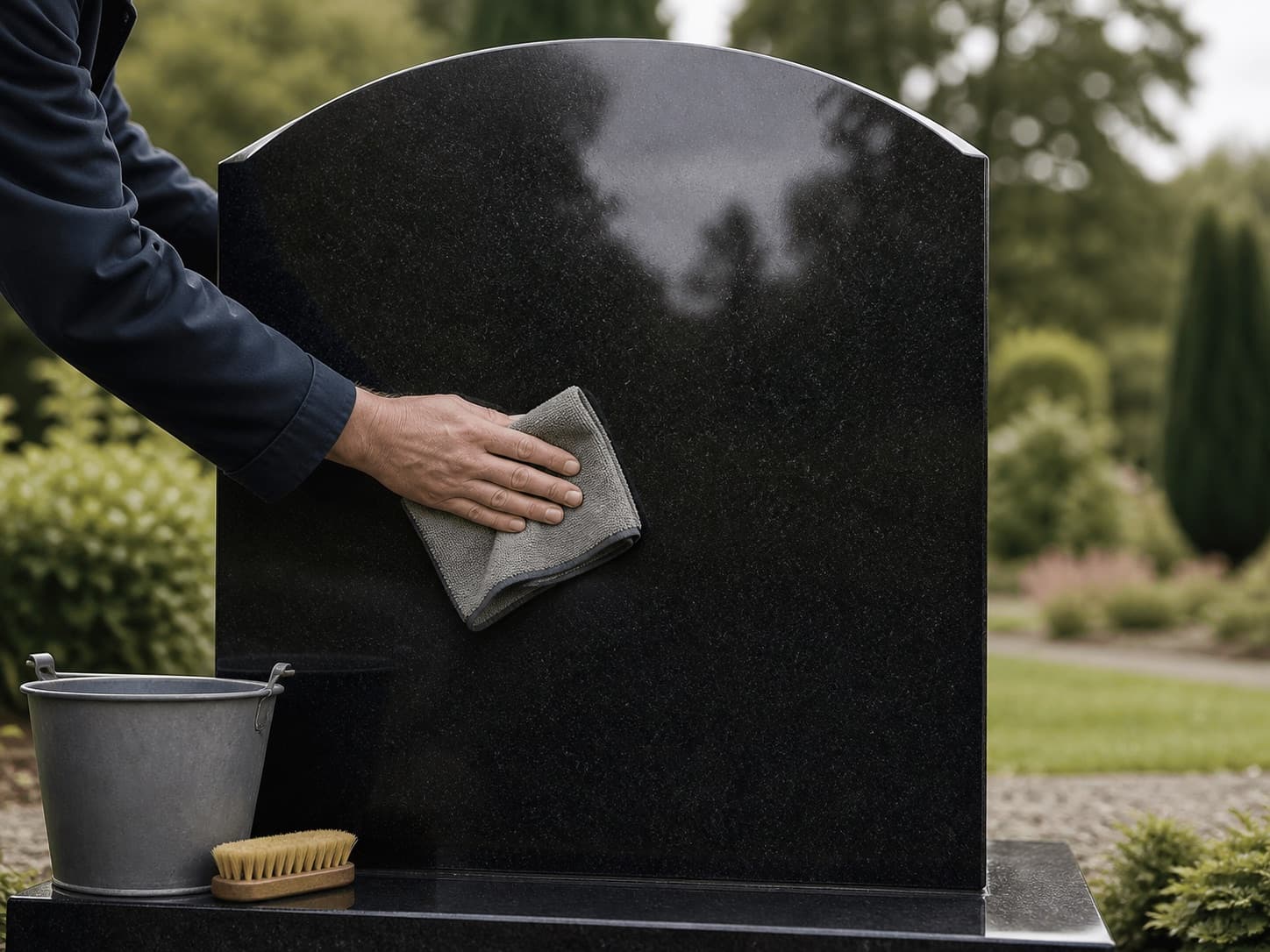
How to Care for a Polished Granite Memorial
Polished granite is one of the most durable materials used for memorials. With simple routine care, it can retain its polished appearance for many years.
Like any outdoor surface, however, a memorial will gradually collect dust, dirt, pollen, bird droppings and other deposits. This guide explains how you can safely carry out routine cleaning at home without unnecessarily risking damage to the stone, painted details or gilded lettering.
It is intentionally limited to simple, low-risk maintenance. More stubborn staining and biological growth may require professional cleaning.
What you'll need :
- Clean Water
- A clean Bucket
- A soft sponge or cloth
- a soft bristle nylon brush (or an old soft toothbrush!)
- Paper towel / microfibres cloth for drying
Before cleaning your memorial
Take a moment to inspect the memorial before you begin.
Check that it appears secure and that there are no obvious signs of movement, open joints, cracks or other damage.
If a memorial is loose, leaning or appears to have moved, don't attempt to straighten or reposition it yourself. Memorials are extremely heavy and should be assessed by an experienced memorial mason. we can take care of this
You should also look at the condition of any painted or gilded lettering and ornamentation. If these finishes are already flaking, lifting or deteriorating, avoid agitating them as cleaning may remove more of the existing finish.
Cleaning polished granite
Begin by wetting the memorial thoroughly with clean water. This will soften and loosen ordinary surface dirt before you begin wiping the stone.
Use a clean, soft sponge or cloth to gently wipe the polished granite. Regularly rinse your sponge or cloth in clean water so that removed dirt and grit aren't continually rubbed across the surface.
If clean water isn't enough to remove general surface dirt, a very small amount of mild washing-up liquid diluted in water can be used on the polished granite, but at your own risk.
Avoid using more detergent than necessary. Once you've finished cleaning, rinse the memorial thoroughly with plenty of clean water so that no detergent residue remains or dries onto the surface.
For dirt caught around edges or other suitable areas of the granite, a soft-bristled nylon brush or toothbrush can be useful. Avoid aggressive scrubbing, if there are stains you can't remove, contact us.
Be particularly careful with lettering
The polished granite itself is extremely durable. Painted and gilded finishes are much more delicate.
We recommend using clean water and very gentle wiping when cleaning over or around inscriptions and ornamentation.
Avoid scrubbing lettering with brushes or abrasive materials. Gold leaf in particular is extremely thin and can be damaged or removed by excessive rubbing.
If an inscription is beginning to fade, flake or lose its finish, cleaning won't restore it. Continuing to scrub the area may actually make its appearance worse.
Painted and gilded inscriptions can usually be professionally renovated and restored when required.
What about green growth and stubborn staining?
You may occasionally find algae, lichen, staining or other deposits that aren't removed by ordinary cleaning.
If gentle cleaning with the methods above doesn't remove them, we recommend stopping rather than experimenting with stronger cleaning products.
Professional memorial cleaning may involve specialist chemical treatments and cleaning techniques. The appropriate treatment depends on the type of stone, its surface finish, the staining being treated, the condition of the memorial and any lettering or ornamentation present.
Our memorial masons may use stronger cleaning products where appropriate, together with the necessary precautions to protect the memorial and its finishes. These treatments require knowledge and experience and aren't something we recommend attempting as part of routine home maintenance.
Products and methods we don't recommend for DIY cleaning
For routine home care, we recommend avoiding strong or specialist chemical cleaners unless you have received specific professional advice for your memorial.
We also advise against using:
- Wire or other metal brushes
- Scouring pads
- Abrasive cleaning powders
- Metal scrapers or blades
- Pressure washers
- Household furniture polishes or waxes
- Undiluted or unknown cleaning chemicals
Some products that aren't suitable for general DIY cleaning may be used professionally in particular circumstances. Their omission from this guide doesn't mean they can never be used on a memorial; their suitability depends on the individual stone, finish and condition.
How often should I clean my memorial?
There is no need to clean a polished granite memorial to a strict schedule.
Its surroundings will make a significant difference. A memorial positioned beneath a tree, for example, may collect considerably more organic material than one in an open area.
Clean the memorial gently when it needs it rather than repeatedly scrubbing it unnecessarily.
When visiting, removing fallen leaves, dead flowers and other debris from around the memorial will also help keep the area tidy.
Take care with flowers and ornaments
Be mindful of anything placed directly against or on top of polished granite.
Dirt or grit trapped beneath flower containers and ornaments can potentially mark the surface if the object is repeatedly moved across it. Metal objects can also corrode and leave difficult staining behind.
When replacing flowers or ornaments, gently lift them rather than dragging them across polished surfaces, and we advise against placing pots, ornaments, anything wrapped in plastic, anything adhesive etc on top of the memorial or its base, these can cause harsh visible outline marks which in some cases cannot be removed.
When should I contact a memorial mason?
Routine cleaning is something most memorial owners can safely carry out themselves. There are situations, however, where professional attention is the better option.
We recommend contacting a memorial mason if:
- The memorial has become loose or unstable
- The memorial is leaning or appears to have moved
- Joints have opened or deteriorated
- Lettering is faded, flaking or requires re-painting or re-gilding
- Green growth or staining remains after gentle cleaning
- The memorial has significant ingrained staining
- There are cracks, chips or other signs of damage
- You're unsure whether a particular cleaning method is safe
Professional cleaning and renovation
There is an important difference between routine home maintenance and professional memorial cleaning.
Experienced memorial masons have access to specialist products and techniques for dealing with staining, biological growth and weathering. Selecting the correct treatment requires an understanding of the stone, its surface finish, lettering and other materials used in the memorial.
For home maintenance, our advice is therefore deliberately simple: start with clean water, clean gently and don't try to force stubborn staining off the memorial.
If gentle cleaning isn't enough, Memorials of Elegance can advise on professional cleaning, lettering renovation, repairs and restoration.